
10 Years of VEGEA: How GrapeSkin is Transforming the Future of Sustainable Fashion Materials
As VEGEA celebrates its 10th anniversary this year, the Italian biomaterials company continues to redefine the future of sustainable materials through science, creativity and circular innovation.
Founded in 2016, VEGEA has pioneered a new approach to transforming agricultural by-products into high-quality bio-based materials, with its award-winning GrapeSkin material created from grape-processing residues. Combining Italian craftsmanship with advanced green chemistry, VEGEA’s innovative material has opened new possibilities across fashion, accessories, footwear, interiors and automotive design.
To mark this important milestone, we speak with VEGEA’s Head of R&D, Marco Valtolina, to discover the journey behind GrapeSkin, the evolution of bio-based materials over the past decade, and the role research and technology will play in shaping a more responsible future for luxury and design.
From expanding production capacity to meeting the growing demand for innovative alternatives, this conversation explores how VEGEA continues to turn sustainability challenges into creative opportunities.
GrapeSkin Marc
Can you tell us a little about your role at VEGEA and what a typical day in research and development looks like?
At VEGEA, research and development is at the core of everything we do. Our work sits at the intersection of chemistry, material science, industrial processing and design, with the objective of transforming bio-based and recycled raw materials into reliable, high-performance materials for real market applications.
A typical day in R&D can involve many different activities: testing new formulations, analysing the behaviour of bio-based polymers, evaluating the quality of raw materials, adjusting coating parameters, or working with production teams to translate laboratory results into industrial processes. We also spend a lot of time characterising the final materials, testing properties such as flexibility, abrasion resistance, colour fastness, hydrolysis resistance and surface performance.
What makes the work especially interesting is that innovation does not stop at the laboratory stage. Every new idea has to be assessed not only for its environmental value, but also for its technical feasibility, scalability, durability and aesthetic quality. This is essential because our materials are used by brands and manufacturers that require consistency, reliability and industrial performance.
VEGEA has pioneered the use of grape waste from the wine industry to create innovative materials. What first inspired this concept, and how has the technology evolved since the company was founded?
VEGEA was founded with a clear ambition: to transform an abundant agricultural by‑product into a high‑performance material, reducing reliance on fossil‑based and animal‑derived resources.
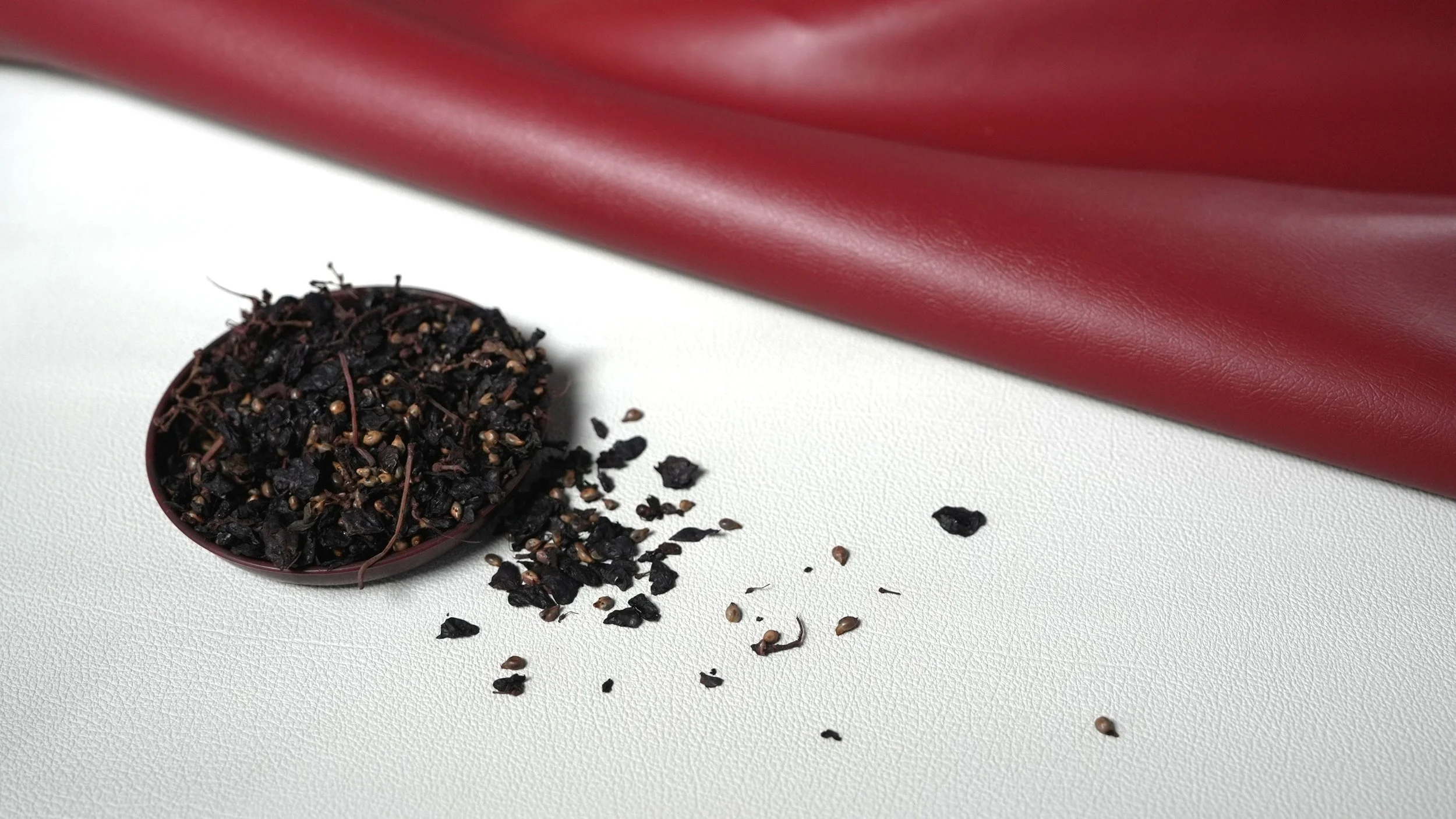
Italy’s wine industry produces large quantities of grape marc every year — skins, seeds and stalks that are often under‑utilised but rich in potential. This made the wine sector a natural starting point for developing a new material platform.
Since its early stages, VEGEA’s focus has been on moving from laboratory research to industrial application. Over time, the technology has evolved into a scalable production process capable of delivering consistent quality, enabling GrapeSkin to be used across multiple industries, from fashion to interiors and mobility.
Today, this evolution is reflected not only in the material itself, but also in the industrial know-how behind it: controlled sourcing, engineered formulations, coating technologies and quality-control systems that allow a bio-based material to meet the expectations of premium brands and manufacturers.
Many consumers are becoming more conscious about the materials used in the products they buy. What makes grape-based biomaterials a compelling alternative to traditional leather and synthetic options?
Grape-based biomaterials such as GrapeSkin offer a compelling alternative because they combine material performance, aesthetic quality and a circular approach to resource use.
GrapeSkin is developed from wine-industry by-products, reducing dependence on virgin fossil-based raw materials and giving new value to agricultural residues. At the same time, it is produced within a controlled, traceable and Made-in-Italy supply chain, which is increasingly important for brands and consumers alike.
From a design and production perspective, it offers consistency in thickness, colour and surface finish, as well as the flexibility required for a wide range of applications. This makes it not only a sustainable choice, but also a practical and scalable solution for industrial use.
Another important aspect is that GrapeSkin is designed as a durable technical material. For us, sustainability is not only about the origin of the raw materials, but also about creating products that can perform over time, reducing the need for frequent replacement.
What are some of the biggest scientific or technical challenges you have faced in developing high-performance biomaterials from agricultural by-products?
One of the main challenges has been managing the natural variability of agricultural by-products while delivering a material with consistent industrial quality. Bio-based inputs can vary depending on origin, season, moisture content and composition, so the challenge is to transform this variability into a controlled and repeatable production process.
To address this, VEGEA works with selected and traceable supply chains, clear specifications for incoming raw materials and carefully engineered industrial processes. The formulation and coating stages are designed to ensure consistency in texture, thickness, colour and mechanical performance across different production batches.
Another important challenge has been scaling the technology from laboratory development to industrial production. Parameters that can be adjusted manually at lab scale, such as formulation ratios, temperature profiles, residence times and drying conditions, must be translated into robust industrial protocols. This requires a strong integration between chemistry, process engineering and quality control.
Finally, developing a high-performance biomaterial means balancing many requirements at the same time: sustainability, durability, flexibility, aesthetics, processability and cost efficiency. The real challenge is not simply creating a bio-based material, but creating one that brands can actually use in demanding applications.

How do you balance sustainability goals with the durability, aesthetics and functionality that brands and consumers expect from premium materials?
At VEGEA, sustainability and performance are not treated as opposing goals, but as interdependent elements of material design.
Our approach is to develop materials that are not only bio-based, but also durable, consistent and suitable for industrial applications. This means ensuring that GrapeSkin meets the technical requirements expected by brands, from mechanical performance to aesthetic quality.
At the same time, we take a careful and transparent approach to sustainability, avoiding claims that are not fully supported. The objective is to create materials that are credible, reliable and scalable, so they can be realistically integrated into long-term production processes.
In premium markets, aesthetics and touch are as important as technical performance. For this reason, we work continuously on surface finishes, textures, colours and thicknesses, while maintaining the material’s traceability and bio-based identity.
Durability is also a key part of our sustainability strategy: a material that lasts longer can reduce replacement cycles and contribute to a lower environmental impact over the full product lifecycle.
The fashion and design industries are evolving rapidly. What trends are currently influencing your research and product development priorities?
Several trends are shaping our research and product development priorities. The first is the growing demand for materials that are not only visually appealing, but also traceable, lower-impact and supported by credible technical data. Brands increasingly want to understand where materials come from, how they are produced and how they perform over time.
Another important trend is the move towards circularity. This means designing materials with greater attention to resource efficiency, recycled inputs, durability and end-of-life strategies. At VEGEA, this strongly influences our work on bio-based formulations, recycled components and potential recycling pathways for technical coated materials.
We are also seeing increasing interest in application-specific materials. Fashion, interiors, furniture and mobility do not all require the same characteristics. A material for a handbag, for example, may prioritise flexibility, texture and colour, while an interior or mobility application may require higher resistance to abrasion, UV exposure, hydrolysis or long-term use.
Also customization is very important. Designers are looking for materials that support creative freedom through different colours, textures, thicknesses and finishes, while manufacturers require reliability and repeatability.

Collaboration often plays a key role in innovation. How does VEGEA work with designers, manufacturers and brands to bring new material solutions to market?
Collaboration is central to VEGEA’s model. As a material supplier, the company works closely with brands, designers and manufacturers throughout the development process.
Projects typically start with sampling and prototyping, allowing partners to explore the material’s aesthetic and technical properties. From there, the collaboration can evolve into product development and industrial-scale implementation, depending on the project’s scope.
This approach allows VEGEA to adapt GrapeSkin to specific requirements, supporting brands in integrating innovative materials into their collections while ensuring consistency and reliability over time.
What misconceptions do people commonly have about plant-based or bio-derived materials, and what would you like consumers to better understand?
One common misconception is that plant-based or bio-derived materials are automatically less durable or less technical than conventional materials, but performance depends on formulation, processing and quality control. A bio-based material can be highly engineered and designed to meet demanding industrial requirements.
Another misconception is that sustainability is determined only by the percentage of natural content. While bio-based content is important, it is only one part of the picture. Durability, traceability, responsible production, chemical safety, resource efficiency and end-of-life options are also essential when evaluating the real environmental profile of a material.
There is also sometimes confusion between different concepts such as bio-based, biodegradable, compostable and recyclable. These terms describe different material properties and should not be used interchangeably. GrapeSkin, for example, is designed as a durable technical material, not as a disposable or compostable material.
What we would like consumers to understand is that responsible material innovation is a complex process. The goal is not simply to replace one ingredient with another, but to design materials that are safer, more traceable, more resource-efficient and still capable of meeting the quality and performance expectations of real products.

Looking ahead, what developments or breakthroughs in biomaterials are you most excited about, both for VEGEA and for the wider industry?
We are particularly excited about the development of new bio-based polymers, alternative binders and circular formulations that can further reduce dependence on virgin fossil resources while maintaining industrial performance. This is one of the most important directions for the future of biomaterials.
For VEGEA, the next phase is about continuing to strengthen GrapeSkin as a reliable material platform while developing new generations of bio-based and recycled materials. Our goal is to expand the range of applications, improve environmental performance and support brands with materials that are both innovative and practical to use.
For the wider industry, one of the most promising developments is the increasing integration between material science, digital process control and circular design. These tools can help biomaterials become more consistent, scalable and accessible, overcoming some of the barriers that have traditionally limited their adoption.
What is especially encouraging is that biomaterials are no longer seen only as experimental alternatives. They are becoming part of serious industrial strategies in fashion, design, interiors and mobility. This creates the opportunity to move from isolated innovation projects to broader transformation across value chains.
For readers interested in sustainability and innovation, what gives you the most optimism about the future of materials and responsible production?
There is a growing recognition across industries that material choice plays a critical role in environmental impact, and this is driving meaningful change.
We are seeing increasing interest from brands in traceable, bio-based and lower-impact materials, as well as a willingness to explore new solutions that go beyond traditional options. At the same time, advancements in material science and industrial processes are making these alternatives more scalable and accessible.
What is encouraging is that sustainability is no longer seen as a niche topic, but as a strategic priority. This creates the conditions for innovation, collaboration and long-term transformation in the way materials are designed, produced and used.
